
How AI Is Transforming the P&C Insurance Value Chain
Artificial intelligence (AI) has moved from the edges of property and casualty (P&C) operations into the working day. AI in P&C insurance now touches submission handling, risk selection, pricing analysis, claims triage, and fraud review, and the logical progression is towards connected workflows rather than isolated pilots. The commercial pressure behind that shift is real: Swiss Re Institute estimates insured natural catastrophe losses at USD 107 billion in 2025, the sixth consecutive year above USD 100 billion. This article looks at where AI in insurance is already working, where it may go next, and what might have to change before an AI-powered insurance value chain becomes normal.
Where AI Is Already Changing P&C Insurance
Most of the insurance value chain now has at least one live AI application somewhere in the market: distribution and quoting, underwriting and risk selection, pricing and portfolio steering, claims handling, fraud detection, and customer service.
It’s important to separate four things that usually get grouped together:
- Traditional automation follows fixed rules and does exactly what it is told.
- Machine learning finds patterns in historical data and produces a prediction or a score.
- Generative AI (gen AI) works with language and images, summarising documents, drafting text, and interpreting photographs.
- Agentic AI adds the ability to plan and carry out a sequence of steps towards a goal, calling other systems along the way.
P&C insurance suits these methods unusually well, because it runs on structured claims histories and rating tables alongside an enormous volume of unstructured submissions, surveys, invoices, and photographs. Adoption has been quick by insurance standards. As a part of an independent study conducted by Research in Finance for Sapiens in 2026, it was observed that more than 8 in 10 P&C technical leaders have AI already in production, and a third (33%) report agentic AI running in production.
The more interesting shift is structural. Early use cases tended to sit inside a single team. The emerging pattern is AI-enabled workflows that pass context between functions, so that what underwriting learns about a risk is available when a claim on that risk arrives.
AI in P&C Underwriting and Risk Selection
Underwriting is where the effect is likely to show first, because so much underwriting time is spent on handling rather than judgement.
Straight-through processing (STP) can take an email and its attachments, identify what has arrived, check it against appetite, and route it to the right desk. Document reading models can understand the text and then extract values from schedules, surveys, loss runs, and broker slips that weren’t designed to be machine-readable.
From there, risk classification and segmentation models can group exposures by characteristics that matter to loss experience rather than by broad industry code. Predictive risk assessment can draw on external data such as property attributes, weather history, and geospatial imagery to indicate how a risk may behave. AI-assisted underwriting decisions typically stop short of binding: the model proposes, flags anomalies, shows the evidence, and a person makes the final decision.
The potential gains are speed and consistency. Two underwriters looking at the same submission on different days may reach different conclusions, and a model applied consistently can narrow that spread. The gap between potential and reality remains wide, though. Capgemini’s World Property and Casualty Insurance Report 2026 found that only 10% of the industry is successfully scaling AI, and that 60% of insurers remain at the exploration or proof-of-concept stage.
AI in Insurance Pricing
Pricing is the most tightly governed part of the chain, and the most careful about new methods.
Predictive models can support pricing decisions by estimating expected frequency and severity from larger and more varied datasets than a conventional rating exercise would use. They may identify patterns in claims and risk data that a linear model misses, such as interactions between building characteristics, occupancy, and local weather exposure. That can allow finer-grained risk segmentation, with rates that reflect the individual exposure more closely than a broad class rate does. At portfolio level, the same models could show where the book is over-exposed, where rate adequacy is drifting, and which segments may be worth growing. This is the gap between pricing intent and portfolio reality that decides margin stability.
The constraints are serious. A pricing model must be explainable to regulators, defensible on fairness grounds, and stable enough to file. EIOPA’s Opinion on Artificial Intelligence governance and risk management, published in August 2025, sets out supervisory expectations on governance, risk management, data quality, and record-keeping for AI systems used in insurance. Any pricing use of AI is likely to need documented model governance, monitoring for unintended proxy effects, and a human owner who can explain the outcome.
AI in P&C Claims
Claims is the part of the value chain where AI touches the customer directly, which raises both the opportunity and the risk.
At first notification of loss (FNOL), conversational and document-reading models can capture the details of an incident, check cover, and open the file without a queue. Claims triage can then sort files by likely complexity, so that a straightforward glass claim follows a different path from a large commercial property loss. Automated document processing handles the invoices, estimates, and engineering reports that arrive afterwards.
Insurers now use computer vision to assess property and motor damage from photographs, estimating repair scope and flagging images that appear inconsistent with the loss description. Similar techniques support fraud detection, where models look for patterns across claims, parties, and suppliers that a single adjuster might not see. Claims severity prediction can estimate the likely final cost early, which may improve reserving. Generative models can also draft customer updates for an adjuster to review and send.
The dependency underneath all this is data. Capgemini’s research found that only 12% of insurers report very high data maturity, despite heavy reliance on unstructured data.
The Rise of Agentic AI in Insurance
Agentic AI is the term for systems that pursue a goal across several steps rather than executing one instruction. Traditional automation runs a fixed path and stops; an agent keeps going until the goal is met or it reaches something only a person can decide.
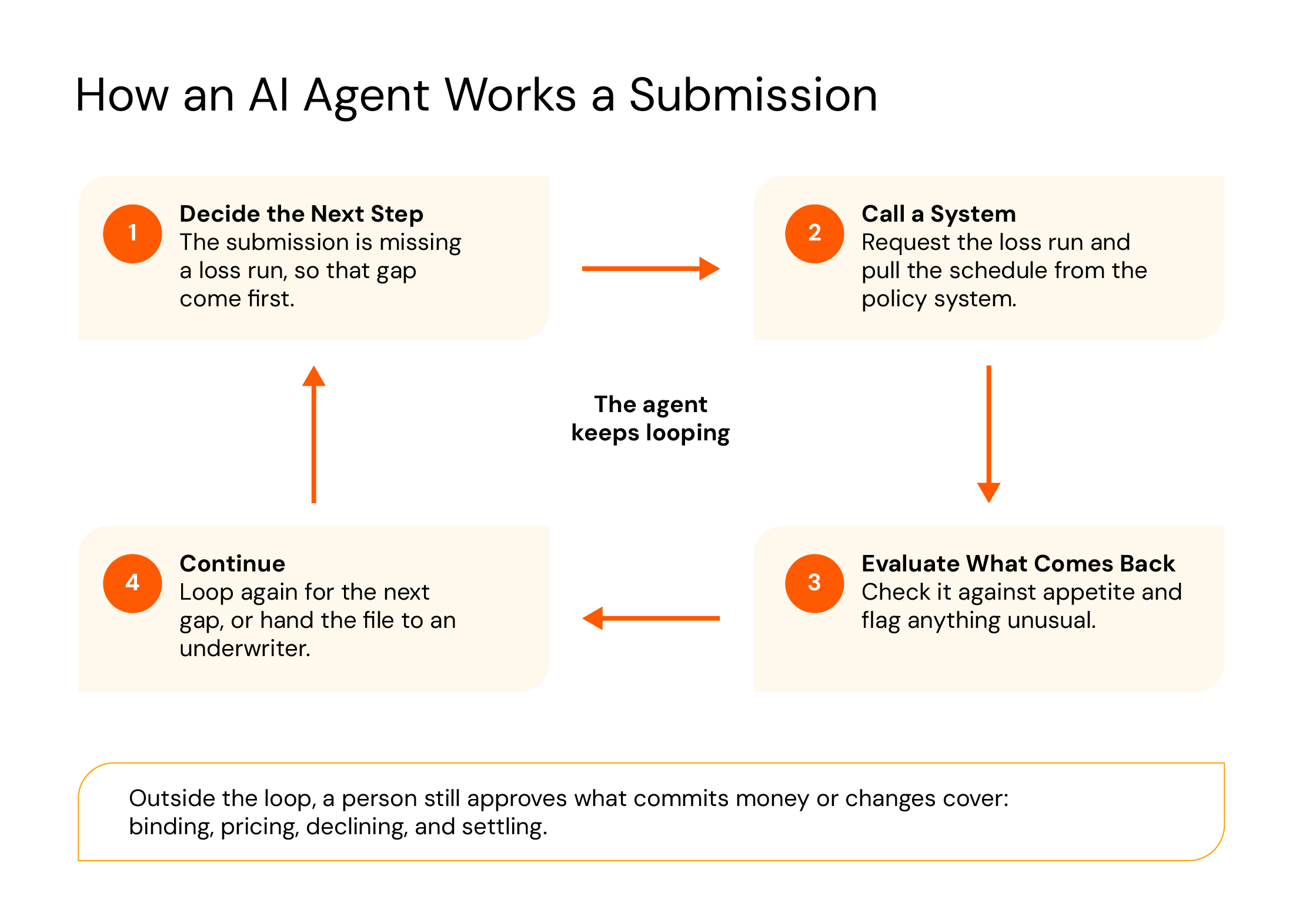
In insurance, that could mean an AI agent assembling a complete submission: retrieving missing documents, enriching the risk with external data, running appetite checks, and presenting a prepared file to an underwriter. In claims, an AI agent might gather the evidence for a decision and set out the options. Interest is running ahead of deployment. Celent reported in May 2025 that 22% of surveyed insurers planned to have an agentic AI solution in place by the end of 2026.
Human approval is likely to stay where the decision commits money or affects a customer’s cover: binding, pricing, declining, and settling. Regulated environments make full autonomy difficult in any case, because an insurer must be able to reconstruct why a decision was made and correct it if it was wrong.
The Challenges of Building an AI-Enabled P&C Insurer
Data, systems, and people usually decide whether an AI programme succeeds.
- Data quality and availability. Deloitte’s 2026 global insurance outlook notes that many insurers struggle with fragmented data and outdated systems, and that realising AI value remains a work in progress.
- Legacy technology and integration. A model is only useful if it can read from and write to the policy, billing, and claims systems, which in many insurers were built decades apart.
- Model governance and explainability. Supervisors expect documented ownership, testing, and monitoring. As of 31 August 2026, 25 states and the District of Columbia had adopted the NAIC Model Bulletin on the Use of Artificial Intelligence Systems by Insurers, with further states applying their own guidance.
- Data privacy and security. Personal and commercial data used for training and inference carries obligations that do not disappear because the processing is statistical.
- Human oversight and adoption. Someone must own each decision, and the people affected must trust the output enough to use it. Organisational change and training tend to decide whether a pilot ever becomes business as usual.
What Could the AI-Powered P&C Insurance Value Chain Look Like?
No one can say with confidence how this settles. A plausible direction is a chain where underwriting, pricing, and claims share the same view of a risk rather than each rebuilding it, with what happens at claim finding its way back into what gets priced.
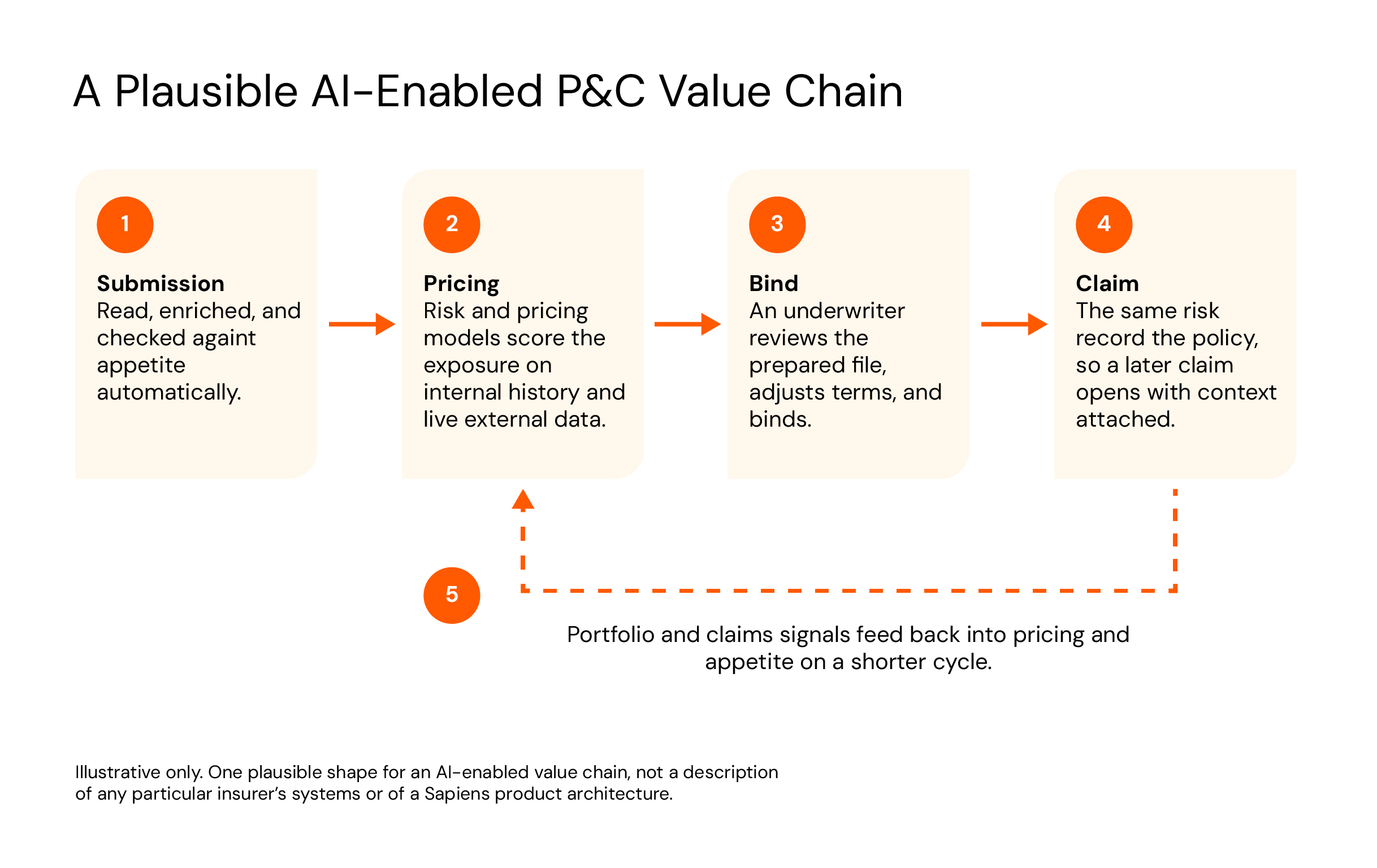
Real-time risk intelligence could change the product itself. If sensor, weather, and imagery data can indicate that a loss is becoming more likely, the insurer’s role may shift from paying for damage towards helping prevent it. That move from reactive cover to predictive risk management is still largely aspirational, and it depends on data foundations most insurers are still building.
Key Takeaways: Preparing for AI-Driven P&C Insurance
Adoption is real but uneven. As a part of an independent study conducted by Research in Finance for Sapiens in 2026, it was observed that 41% of P&C respondents fall into the two least mature segments, and only about a third have a master data strategy or an AI governance policy fully in place. Data readiness and governance, not the choice of model, most often decide the outcome.
In practice, that suggests:
- Design governance in from the start rather than adding it as a compliance step at the end
- Keep a person in the approval path wherever a decision commits money or affects cover
- Start from one shared understanding of a risk across underwriting, pricing, and claims, which is more likely to deliver an advantage than any single use case
Where Sapiens Fits
Working out where AI belongs in your own operations usually comes down to what your core systems can carry. Sapiens builds AI into the core itself rather than alongside it. That core is Sapiens P&C Foundation, which runs policy administration, billing, and claims for personal and commercial lines. The Sapiens Autonomous Insurance Platform (SapiensAIP) is the AI layer within the same platform, built in rather than bolted on, where agentic AI does the work, grounded in more than 40 years of experience. Underwriting, pricing, and claims then work from the same understanding of a risk rather than each building their own.
Explore Sapiens Property & Casualty Solutions
Frequently asked questions
How is AI being used in P&C insurance?
Insurers use AI across the P&C value chain: reading and classifying submissions, extracting data from unstructured documents, scoring and segmenting risk, supporting pricing analysis, triaging claims from first notification of loss, assessing damage from photographs, detecting fraud patterns and drafting customer communications. Most deployments assist a person rather than replace the decision.
How will AI transform insurance?
AI is likely to change how insurance work is organised rather than what insurance is. Routine handling may be automated, allowing specialists to concentrate on complex risks and disputed claims. Connected AI across underwriting, pricing, and claims could also shorten feedback loops. The pace will depend on data quality, system modernisation, and regulatory comfort.
What is generative AI in insurance?
Generative AI refers to models that produce language or images rather than only a score. In insurance, it is typically used to summarise long documents such as surveys and loss runs, extract information from unstructured material, draft correspondence, and answer questions in natural language. Output is normally reviewed by a person before it reaches a customer.
What is agentic AI in insurance?
Agentic AI describes systems that pursue a goal across multiple steps, deciding what to do next and calling other systems along the way, rather than following one fixed instruction. An AI agent might assemble a submission by retrieving documents, enriching data, and running appetite checks. Approval of binding or settlement decisions generally stays with a person.
How is AI used in insurance underwriting?
In underwriting, AI can process incoming submissions, extract values from schedules and broker documents, classify and segment risk, and predict how an exposure may perform using internal and external data. It can flag anomalies and present the supporting evidence. The underwriter usually retains the decision on appetite, terms, and price.
How is AI used in insurance claims?
In claims, AI can capture FNOL, verify cover, triage files by likely complexity, process invoices and reports, assess damage from photographs using computer vision, flag potential fraud, and predict likely severity to support reserving. It can also draft updates for adjusters to review. Complex or disputed losses still need human handling.
Can AI automate insurance processes?
AI can automate parts of many insurance processes, particularly repetitive handling such as data capture, document classification, validation, and routing. Full end-to-end automation is most realistic for simple, high-volume, low-value transactions. Where a decision commits money or affects cover, insurers generally keep a person in the approval path for governance reasons.
What is the future of AI in insurance?
The direction appears to be from isolated tools towards connected workflows, where underwriting, pricing, and claims share the same view of a risk. Agentic approaches may coordinate multi-step tasks under human approval. If real-time risk data matures, insurance could shift further towards prevention. Progress is likely to depend on data foundations and governance rather than model capability alone.