
How P&C Insurers Can Assess Risks They Haven’t Seen Before
Every underwriting decision assumes the past can teach you about the future. For most of what a property and casualty (P&C) insurer covers, it can: decades of claims data let you price motor, home, and liability with confidence. New emerging risks in P&C insurance break that pattern. When a risk has almost no loss history, or its exposure is changing faster than the data can follow, the actuarial footing gives way, and the question shifts from “how much will this cost?” to “how do we assess something we have not seen before?” This article is about how insurers assess that uncertainty.
Why Emerging Risks Are Difficult to Underwrite
Underwriting is pattern recognition applied to history, and emerging risks are hard because the history is thin. With limited historical claims data, an actuary cannot derive a stable frequency or severity distribution, so pricing leans on judgement rather than a statistical base.
The exposures also move. Cyber is the clearest rapidly changing exposure, its technology, attacker behaviour, and regulation shifting year to year. Munich Re estimates the global cyber insurance market at 15.3 billion USD in 2024, less than 1% of global P&C premium, and expects it to more than double by 2030, forming faster than any stable loss record. Frequency and severity stay uncertain: insurers may agree a risk is real yet differ by an order of magnitude on how often, or how badly, it could strike. Even a studied peril shifts its baseline, and Swiss Re Institute reports insured natural-catastrophe losses have topped 100 billion USD for six straight years.
Emerging risks are also interconnected: one cyber outage can trigger business interruption, supply-chain, and liability claims at once, striking several lines together. All of which makes loss scenarios hard to define, and a loss you cannot describe, you cannot reliably price, reserve for, or retain by choice.
How Insurers Identify Emerging Risks
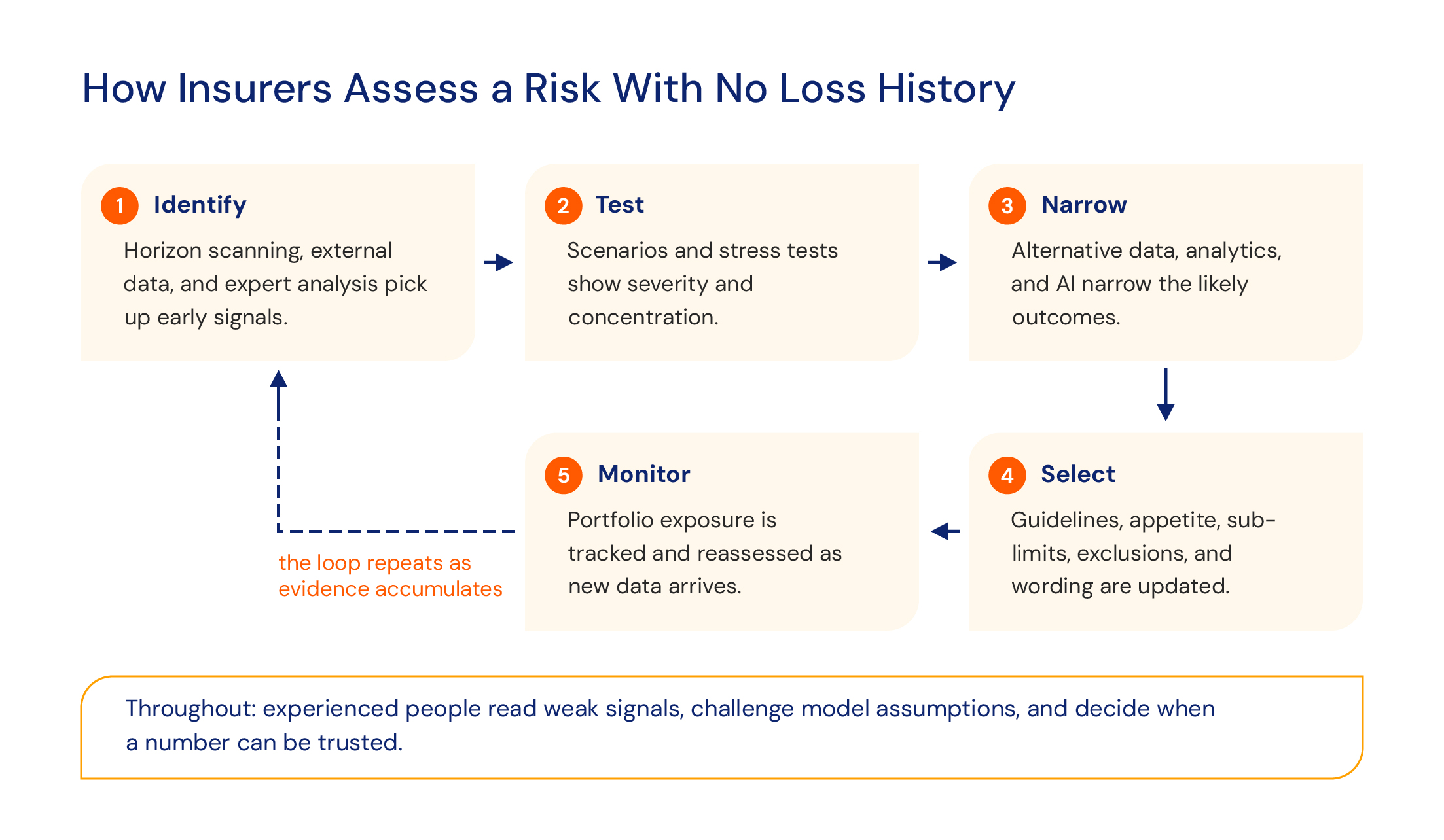
If emerging risks cannot be priced from history, the first discipline is to spot them early. Most insurers run some form of horizon scanning: a structured effort to look beyond the current portfolio for risks that could matter in three, five, or ten years. Because the internal record is silent on risks that have produced no claims, this draws on external data: scientific research, regulatory publications, threat intelligence, catastrophe models, and macroeconomic analysis. Expert analysis turns signal into something usable, as catastrophe modellers, cyber specialists, climate scientists, and legal analysts read what a trend means for specific lines. Their input feeds scenario development, the bridge to testing covered next. All of it rests on monitoring changes in technology, regulation, and society, since emerging risk is usually a by-product of change elsewhere. AXA’s Future Risks Report 2024, found 87% of experts believe the world has grown more vulnerable, ranking climate change, geopolitical instability, cyber, and AI-related risks at the top.
The Role of Scenario Analysis and Stress Testing
When data is too thin to model a risk statistically, scenario analysis becomes the main tool. Instead of asking what the numbers say, insurers ask: if this happened, what would it do to our business? The work starts with creating plausible scenarios, detailed enough to test yet disciplined enough to defend. A Lloyd’s systemic risk scenario, built with the Cambridge Centre for Risk Studies, models a hypothetical but plausible cyber-attack on a major payments system and estimates a 3.5 trillion USD global economic loss over five years; its worth lies less in the figure than in reasoning about an event with no precedent.
The scenario is then used for testing portfolio exposure, run across the live book to see which policies respond and how losses accumulate. This meets stress testing, which regulators increasingly expect: EIOPA’s 2024 insurance stress test applied a severe geopolitical scenario and found European insurers’ aggregate solvency ratio could fall from 221.8% to 123.3% before management actions. Scenarios also aid understanding potential severity where no historical maximum exists, and identifying concentrations, revealing that supposedly independent exposures cluster in one region, technology, or counterparty. Their value is using scenarios where historical data is insufficient, exactly where emerging risks sit.
How Data and Analytics Can Help Manage Uncertainty
Scenarios set the outer bounds; data and analytics narrow what is likely. Where pricing data is scarce, insurers turn to alternative data, using satellite and aerial imagery, Internet of Things (IoT) sensors, geospatial layers, and telematics to describe an exposure that has produced few claims. Predictive analytics looks for structure in those inputs, using statistical and machine-learning models to estimate behaviour from a small sample. External datasets add climate projections, economic indicators, or threat feeds, while real-time information lets some exposures be monitored continuously rather than only at renewal. AI-assisted pattern recognition is becoming central, and adoption is broad: a Bank of England and FCA survey found 75% of financial-services firms using AI, with insurance the highest of any sector at 95%. Used well, such models reveal correlations a human might miss; used carelessly, they create false precision, since a model trained on the past may be least reliable about a novel risk. Data widens what an insurer sees and quickens its response, but informs judgement rather than replacing it.
How Insurers Develop New Approaches to Risk Selection
Assessment matters only if it changes what an insurer writes. As a risk comes into focus, that view feeds into risk selection, starting with updating underwriting guidelines: the questions at submission, the information required, and the criteria that accept, load, or decline a risk. Insurers also revisit their risk appetite, deciding how much exposure to a still-uncertain risk to hold, which may mean smaller lines, tighter aggregate limits, or a slower build. That drives developing new coverage approaches: sub-limits, clearer exclusions, explicitly named cover, or parametric structures paying on a measured trigger rather than a modelled loss. Precise wording is itself risk assessment, since ambiguity can turn a manageable exposure into an unintended one. None of this remains static: emerging risks call for active portfolio monitoring, tracking how aggregate exposure builds across the book, and continuous reassessment as new data arrives. Treating risk selection as a loop, not a one-off decision, is what keeps portfolio risk in check.
The Role of Human Judgement in Emerging Risk
For all the modelling, emerging risk stays a matter of judgement, because the evidence is rarely complete enough to decide on its own. Expert judgement fills the gap between what the data shows and what a decision needs. Much of the skill lies in interpreting weak signals: telling an early indicator of a real trend from ordinary noise before the pattern is statistically clear. Human oversight also means challenging model assumptions. A model is only as sound as its inputs, and an experienced underwriter or risk officer is often the one to ask whether a correlation still holds. Governance frames these judgements through risk committees, underwriting authorities, and review, keeping decisions consistent and accountable. The aim is not caution for its own sake but balancing uncertainty with commercial opportunity: an insurer that assesses an emerging risk more clearly than its competitors may be better placed to write it, at the right price, when others hesitate.
What Will Emerging Risk Management Look Like in the Future?
No one can say precisely how emerging risk management will evolve, but the direction of travel suggests what it might look like. Several shifts already under way seem likely to continue:
- More continuous monitoring, with key exposures watched in near real time rather than at fixed points
- Greater use of scenarios, across more of the portfolio, not just the largest perils
- More dynamic risk models that update as fresh data arrives, shortening the gap between a change in the world and a change in the view
Cross-functional risk teams bringing underwriters, actuaries, data scientists, and domain experts together, since no one discipline sees an interconnected risk whole. Running through all of these is a closer combination of technology with expert judgement. The more capable the models, the more it may matter that experienced people frame the questions, weigh the outputs, and decide when a number can be trusted. The likely destination is not a fully automated view of risk but a faster, better-informed exchange between the models and the people accountable.
Key Takeaways: Preparing for Risks Without a Clear Historical Record
Risks without a clear historical record cannot be underwritten by the usual means, but they can still be assessed with discipline. A few principles hold across the approaches above:
- Treat scarce data as a prompt for structured judgement, not a reason to guess
- Use scenario analysis and stress testing to reason about severity and concentration where loss history is missing
- Let data, analytics, and AI widen the view and speed the response, while keeping their limits in mind
- Build risk selection as a loop, revisiting appetite, guidelines, and wording as evidence accumulates
- Keep experienced people in the decision, to read weak signals and challenge the models
None of this removes uncertainty. The aim is to hold it consciously, price it where you can, and decline it where you cannot, so an unfamiliar risk is a considered choice, not an accident.
Where Sapiens Fits
Assessing a risk you have never seen before draws on everything above: external data, scenarios, analytics, and the judgement to act once your view changes. Sapiens P&C insurance software brings those together, so you can evaluate unfamiliar exposures, adjust appetite and wording quickly, and keep reassessing as new evidence arrives rather than waiting for the next renewal.
Explore how Sapiens P&C insurance software can help insurers modernise their operations and respond to changing market requirements.
Frequently asked questions
What are emerging risks in P&C insurance?
Emerging risks in P&C insurance are threats that are new, fast-changing, or poorly understood, and so lack the reliable loss history insurers use to price cover. Examples include cyber attacks, AI-related risks, and shifting climate exposures, where frequency and severity are hard to quantify with confidence.
How do insurers assess emerging risks?
Insurers assess emerging risks by combining methods rather than relying on claims data alone. They scan the horizon for early signals, draw on external data and expert analysis, and build scenarios to test how a loss could unfold, with analytics and experienced judgement narrowing the range of outcomes.
Why are emerging risks difficult to insure?
Emerging risks are difficult to insure because there is little or no loss history to price against, and the exposure is often changing quickly. Frequency and severity are uncertain, and the risks tend to be interconnected, so one event can affect many policies at once.
How do insurers assess risks with limited historical data?
With limited historical data, insurers lean on scenario analysis, expert judgement, and alternative data rather than statistical pricing alone. They build plausible loss scenarios, stress-test them across the portfolio, and use external datasets such as satellite imagery to describe exposures indirectly, treating model outputs as indicators rather than certainties.
What is scenario analysis in insurance?
Scenario analysis in insurance assesses risk by asking what would happen if a specific event occurred, rather than deriving probabilities from past data. Insurers build detailed, plausible narratives, then run them across the portfolio to gauge potential losses and concentrations. It suits emerging risks, where historical data is too thin to model directly.
How do insurers manage uncertainty?
Insurers manage uncertainty by widening their view of a risk and adjusting how much they hold. They gather external data, test scenarios, and monitor exposures continuously, then shape risk appetite, underwriting guidelines, and policy wording to match their confidence. Uncertainty is held consciously rather than eliminated.
What is emerging risk management?
Emerging risk management is the set of practices insurers use to identify, assess, and respond to risks that lack a clear loss history. It spans horizon scanning, scenario analysis, stress testing, analytics, and governance, working as a continuous loop that revisits assumptions as risks develop.