
Property & Casualty Insurance
P&C Insurance: The Complete Guide to Property & Casualty Insurance
P&C insurance, or property and casualty insurance, protects people and businesses against damage to what they own and against liability for harm they cause. How an insurer selects risks, prices them, settles claims, models catastrophes and buys reinsurance all feed one another, and each is now being reshaped by climate change, new exposures and artificial intelligence (AI). This guide to the P&C insurance industry follows that chain from first principles to the forces changing it. Each section introduces a topic, shows how it connects to the others and points to an in-depth article for the details. It is written for anyone who needs the full picture of how P&C insurance fits together, from product, finance and technology teams to professionals new to the industry.
In This Guide
What Is P&C Insurance?
P&C insurance covers financial loss from damage to property and from legal liability to others. Property cover pays for physical damage to or loss of assets such as buildings and vehicles. Casualty cover, also called liability cover, pays when a policyholder is legally responsible for injury or damage to a third party.
The two halves answer different questions. Property insurance covers the insured’s own assets, including the income lost while a damaged building or machine cannot be used. Casualty insurance responds to claims from other people: an injured customer, a damaged neighbouring building or a professional error. Major P&C insurance lines include:
- Personal auto (motor) and home insurance, covering vehicles and houses
- Commercial property, covering buildings, equipment and business interruption
- General liability and professional indemnity, covering third-party injury, damage and error
- Workers’ compensation and employers’ liability, covering injury to employees
- Specialty lines such as marine, aviation, cyber and political risk
Within the wider insurance industry, P&C insurance sits alongside life and health insurance but works differently. Contracts are usually annual and repriced at renewal, losses depend on physical assets and legal systems, and a single event can generate thousands of claims at once. That volatility is why P&C insurers rely on reinsurance and capital markets, and why supervisors scrutinise their solvency closely. To see how the pieces operate in practice, it helps to follow a policy from first assessment to final claim.
How Does P&C Insurance Work?
P&C insurance works by pooling premiums from many policyholders to pay the losses of the few who suffer them. An insurer assesses and prices each risk, issues and administers the policy, settles valid claims, and transfers part of its largest exposures to reinsurers. Each step depends on information produced by the one before.
The lifecycle starts with risk assessment. Underwriters and actuaries judge whether a risk fits the insurer’s risk appetite and what it is likely to cost. Pricing converts that judgement into a premium meant to cover expected claims, expenses, reinsurance and a return on capital. Policy administration then issues the contract, collects premium and handles changes through the policy period. When a loss occurs, claims teams verify cover, assess the damage and pay. Reinsurance runs alongside the whole chain, moving part of the largest exposures to reinsurers so that one event does not exhaust the insurer’s capital.
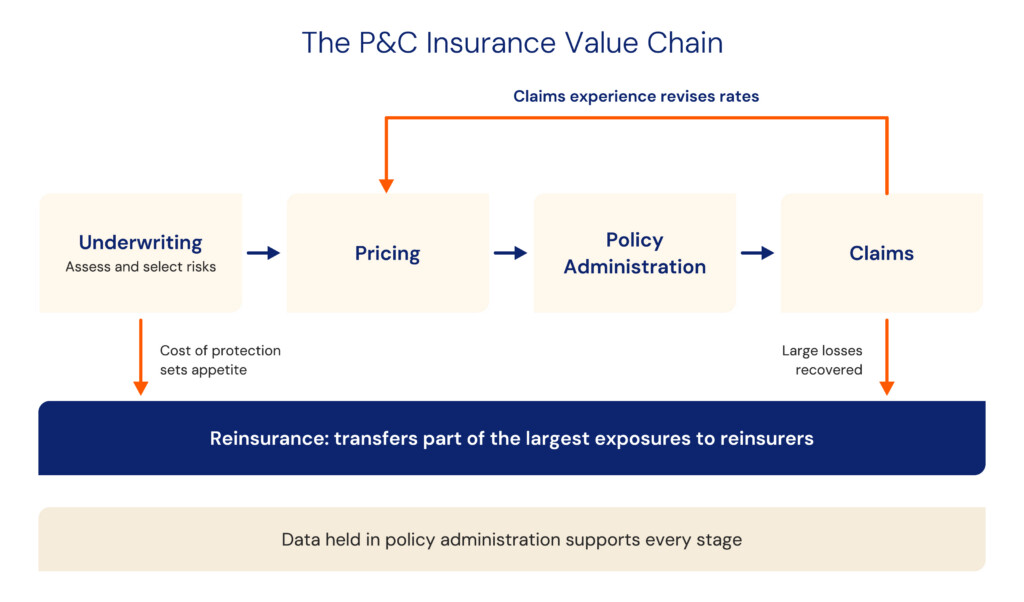
Claims experience feeds back into pricing, because loss data is the evidence on which rates are revised. Pricing and risk appetite depend on reinsurance, because the cost and availability of protection set how much risk an insurer can keep. Policy administration holds the data that underwriting, claims and reinsurance all draw on, so gaps there surface everywhere downstream. When one link works from outdated information, the others inherit the error. Climate change, emerging risks and AI matter across the P&C insurance value chain for this reason: each puts pressure on several links at once. Underwriting is where the chain begins, and where the quality of information first counts.
P&C Insurance Underwriting
P&C insurance underwriting is how an insurer decides which risks to accept, on what terms and at what price. Underwriters assess the likelihood and potential cost of a loss using submission details, loss history, exposure data and professional judgement, then accept, decline or modify the risk. Pricing and policy wording turn that decision into a contract.
Traditionally, that assessment rested on historical loss data, the underwriter’s experience and manual review of documents. Each element looks backwards, which works well when exposures are stable. As exposures change faster than loss histories, insurers are now adding data the old processes could not use: property attributes, satellite and aerial imagery, sensor feeds and the unstructured text of broker submissions. Analytics can then move assessment from describing what similar risks have cost towards estimating what a specific risk is likely to cost and can then apply risk appetite rules more consistently across a team. For P&C underwriting, the practical limits are data quality and explainability: an enriched field helps only if it is accurate, and a score helps only if the underwriter can explain it to a broker, an auditor or a regulator.
The underwriter’s role may shift as a result of automation and AI use. As submission handling and data gathering become automated, more time could go to complex accounts, portfolio decisions and oversight of model output, where judgement still matters most. Where that change may lead, including the skills underwriters could need and the human review regulators expect, is the subject of a supporting article on how data and AI could reshape underwriting. Whatever an underwriter accepts today becomes the claims an insurer must settle tomorrow.

Go deeper
What the Future of P&C Insurance Underwriting Might Look Like
The future of P&C insurance underwriting is opening up. Insurers can now reach more data than any previous generation of underwriters could: telematics feeds, satellite imagery, building-level hazard…
P&C Insurance Claims
The P&C insurance claims process begins when a policyholder reports a loss and ends when the insurer settles or declines it under the policy terms. In between, the insurer verifies cover, investigates and assesses the damage, sets a reserve for the expected cost, and pays it out. This is where policyholders judge an insurer most directly.
The lifecycle usually runs from first notification of loss (FNOL) through triage, investigation and assessment to settlement and, where relevant, recovery from third parties. Assessment is often the slowest stage, because it involves scoping damage, estimating repair costs and checking the claim against the policy. Modern echnology is changing each step: digital reporting captures details at the outset, computer vision can read photographs and aerial imagery, and rules or models can route simple claims for fast settlement while referring complex ones to an adjuster.
Cost pressure raises the stakes. Swiss Re Institute’s sigma 2/2026 report expects property rebuilding to cost 7% more in the US and 11% more in Germany by 2027, as inflation feeds through to repair and replacement. Insurers that assess and settle accurately and quickly are likely to be better placed to manage that. Our in-depth article looks at how AI and automation could change claims handling, from FNOL to settlement, and at why adjusters are likely to remain central for complex, disputed and sensitive claims.

Go deeper
The Future of P&C Insurance Claims: From Automation to AI
AI in P&C insurance claims is moving from pilot projects towards everyday operations, and that shift could change how insurers handle every stage of a claim, from first…
Climate Risk and Catastrophe Exposure
Climate risk affects P&C insurance by changing how often, where and how severely weather-related losses occur, which weakens the assumption that past claims predict future ones. Insurers are affected first in property lines, through higher catastrophe losses, shifting exposure, harder risk assessment and, after severe years, higher reinsurance costs.
The long-term direction is clear even when individual years are not. Swiss Re Institute reports that long-term global insured losses from natural catastrophes continue to grow at 5% to 7% a year. Its sigma analysis attributes more than 80% of the long-term rise in weather-related insured losses between 1970 and 2025 to exposure growth, meaning more valuable property in harm’s way, while noting that in some regions and perils hazard changes are becoming material as well. Population growth, rising asset values and higher reconstruction costs add to the effect. For an insurer, the property exposure is changing, and in some places so is the hazard it faces. P&C risk management therefore means tracking where value is concentrating as well as how the weather behaved last year.
That combination moves risk assessment from territory averages towards the individual building: its location, construction, roof and the mitigation measures it has in place. It also raises questions of accumulation, affordability and insurability in the most exposed areas. Our in-depth article covers how climate risk is changing property, including property-level data, verified mitigation and the protection gap. Quantifying exposure on this scale is exactly what catastrophe modelling does.

Go deeper
How Climate Risk Is Changing Property & Casualty Insurance
Climate risk is changing property and casualty (P&C) insurance faster than most pricing and underwriting frameworks were designed to absorb. Longer fire seasons, heavier rainfall, and shifting storm…
Catastrophe Modelling
Catastrophe modelling in insurance uses simulation to estimate the losses a portfolio could suffer from rare, severe events such as hurricanes, earthquakes, floods and wildfires. Models combine hazard, exposure and vulnerability to produce a range of possible outcomes, from a typical year to a once-in-a-century event, so insurers can price and manage accumulation with evidence.
Each of these three inputs answer a different question:
- Hazard describes the event: how often it could occur and how intense it would be at each location.
- Exposure describes what is in its path: the buildings, contents and values the insurer has covered.
- Vulnerability describes how those assets respond: how much damage a given intensity is likely to cause to a given type of structure.
Policy terms then convert damage into insured loss.
Insurers use the results in three connected ways:
- In underwriting and pricing, they show which locations carry the highest catastrophe load.
- In portfolio management, they reveal where risk is concentrating so that no single event can take more than the insurer can absorb.
- In reinsurance and capital planning, they inform how much protection to buy and how much capital to hold.
Model output carries real uncertainty, and different providers can reach different answers for the same portfolio, so it works best as decision support alongside expert judgement. Our in-depth article explains how insurers use catastrophe, from the inputs and modules to secondary perils and limitations. Models depend on a loss record to calibrate against, and some of the fastest-growing exposures do not yet have one.

Go deeper
Catastrophe Modelling: How Insurers Assess Property Risk
Every property insurer faces the same hard question: how much could a single hurricane, earthquake, or wildfire cost your business in one bad year? Catastrophe modelling is the…
Emerging Risks in P&C Insurance
Emerging risks in P&C insurance are new or fast-changing exposures that lack the loss history insurers normally use to price cover. Examples include cyber, AI-related liability and new technologies or materials. Without reliable frequency and severity data, insurers rely on scenario analysis, expert judgement and alternative data.
Several features make these risks difficult. A limited record means actuaries cannot derive stable loss distributions. Exposures change faster than data accumulates. Losses can also be correlated, so one event may trigger claims across property, liability and cyber policies together, which makes the accumulation hard to define and therefore hard to price. Swiss Re Institute estimates that hyperscaler spending on AI infrastructure should reach USD 750 billion in 2026, and expects those assets to raise demand for protection across property, engineering, cyber, liability and business interruption cover. Large new asset classes can arrive faster than insurers can learn their loss patterns.
In practice, insurers combine methods. Horizon scanning spots signals early. Scenario analysis and stress testing show how a loss could unfold across the portfolio. Expert judgement fills the gap between what the data shows and what a decision needs, and risk selection is revisited as evidence builds. Our in-depth article on assessing risks insurers have not seen before covers each of these methods and how risk selection can become a continuing loop.

Go deeper
How P&C Insurers Can Assess Risks They Haven’t Seen Before
Every underwriting decision assumes the past can teach you about the future. For most of what a property and casualty (P&C) insurer covers, it can: decades of claims…
AI and the Future of P&C Insurance Operations
AI is changing P&C insurance by automating data-heavy work across underwriting, claims and operations: reading submissions and documents, scoring risk, triaging claims and assessing damage from images. In most cases it assists people rather than replacing them, with human oversight kept wherever a decision commits money or affects cover.
Adoption is moving, though not evenly. As a part of an independent study conducted by Sapiens, it was observed that 86% of P&C respondents rated agentic AI as very or quite important to their business, while 63% said they were mostly ready, fully ready or had already adopted it.
Across the value chain, AI is being applied to submission intake and risk scoring, to triage, damage assessment and fraud detection, and to document handling and customer communication. Agentic AI, which pursues a goal across several steps autonomously, could extend this further, though approval of binding, pricing and settlement decisions is likely to stay with people. Roles may shift towards interpreting model output, handling exceptions and owning decisions. Our in-depth article sets out what a connected, AI-enabled value chain could look like, along with the data, governance and legacy-system barriers.

Go deeper
How AI Is Transforming the P&C Insurance Value Chain
Artificial intelligence (AI) has moved from the edges of property and casualty (P&C) operations into the working day. AI in P&C insurance now touches submission handling, risk selection,…
The P&C Insurance Market Cycle
A hard insurance market is a phase of the cycle in which premiums rise, capacity tightens and underwriting becomes stricter, usually after heavy losses or a fall in capital. A soft market is the reverse: capacity is plentiful, competition pushes prices down and terms broaden. The P&C insurance market moves between the two as results and capital change.
Pricing, capacity, claims, reinsurance and underwriting risk appetite move together. Pricing rises or falls as insurers seek rate adequacy or compete for share. Capacity expands when capital is abundant and contracts after losses. Claims, including catastrophe losses and claims inflation, can erode capital quickly or leave it intact. Reinsurance costs flow into primary pricing, because insurers pass on the price of the protection they buy. Underwriting risk appetite widens in soft markets and narrows in hard ones, which is why discipline is hardest to hold when prices fall.
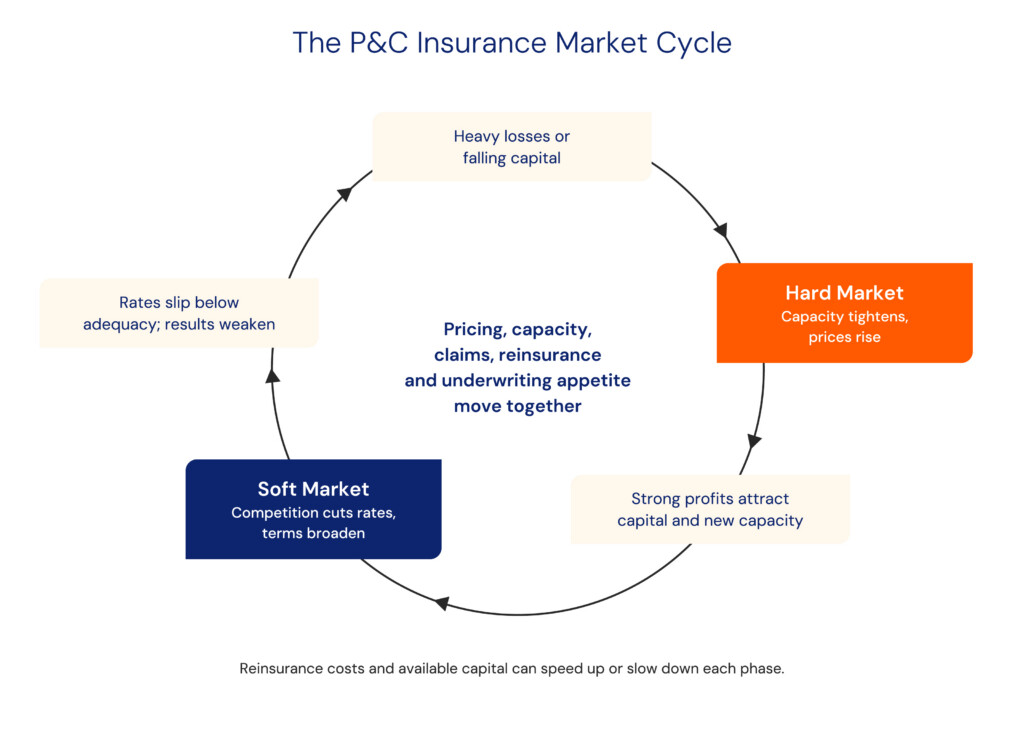
Current signals point towards softening. Swiss Re Institute forecasts global non-life real premium growth of 0.6% in 2026, well below the long-term trend of 3.6%, and return on equity easing to 11.4% from a 14% peak in 2025. Swiss Re Institute also suggests this soft phase may be shallower than past ones, because claims inflation and catastrophe exposure could prompt insurers to reprice sharply if conditions deteriorate. Our in-depth article explains what drives the hard and soft phases, including the role of reinsurance and what could shape the next turn.

Go deeper
The P&C Insurance Market Cycle: Hard vs Soft Markets Explained
Anyone who has renewed a P&C insurance programme several times has seen prices climb sharply, then drift back down. The P&C insurance market cycle describes that swing between…
The Future of P&C Insurance
The topics covered in this guide are not separate stories. Climate and catastrophe exposure raise losses and feed catastrophe models. Those models inform underwriting, portfolio and reinsurance decisions. Reinsurance and capital then shape the market cycle, which sets pricing and appetite. Emerging risks add exposures with no record to model, while AI and data are changing how every stage is run. The market’s direction is likely to be set by how these trends interact.
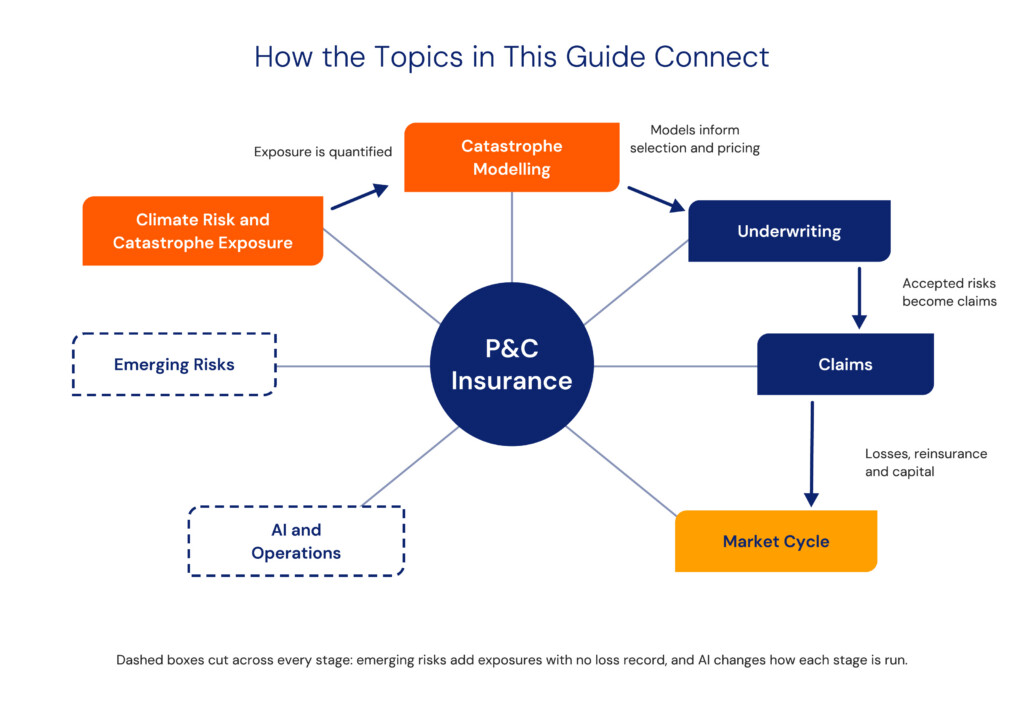
The main trends affecting the sector are:
- AI and automation: Routine handling in underwriting, claims and operations may be automated further, with people owning the decisions that commit money or affect cover.
- Data-driven underwriting: Property-level and external data could make risk selection more detailed and more consistent, if insurers can keep that data accurate.
- Climate and catastrophe risk: Exposure is likely to keep growing, which would keep catastrophe modelling and mitigation central to property pricing.
- Emerging risks: New technologies could produce exposures that need scenario analysis and judgement long before a loss record exists.
- Claims transformation: Faster digital handling may raise policyholder expectations, with adjusters focused on complex and sensitive cases.
- Changing insurance operations: Connected workflows could let underwriting, pricing and claims share one view of a risk.
- Market and capacity pressures: Softening conditions and abundant capital may be tested by large losses or inflation.
Explore the Full Guide






Frequently Asked Questions
How will AI change P&C insurance underwriting?
AI is likely to change P&C insurance underwriting by automating the assembly of information rather than the decision itself. Submission intake, document extraction, data enrichment, and initial triage could run automatically, while underwriters concentrate on complex or unusual risks.
How is AI being used in insurance claims?
Insurers use AI across the claims process: digital FNOL and automated data capture, triage and routing, computer vision for photo-based damage assessment, document processing, fraud detection, and settlement support. In most cases the technology assists adjusters by preparing information and recommending actions, while people keep responsibility for complex, disputed, or sensitive claims.
What is the P&C insurance market cycle?
The P&C insurance market cycle is the recurring shift between hard and soft conditions in property and casualty insurance. In hard markets, premiums rise and capacity tightens. In soft markets, capacity is plentiful and prices fall. It’s driven by losses, claims inflation, capital, reinsurance costs, investment returns, and competition.
What is catastrophe modelling in insurance?
Catastrophe modelling in insurance estimates the potential losses from rare, high-severity natural events such as hurricanes, earthquakes, floods, and wildfires. By simulating thousands of possible disaster scenarios, catastrophe models help insurers quantify property risk, set prices, and decide how much reinsurance and capital they need for a severe year.
How does climate change affect P&C insurance?
Climate change affects P&C insurance mainly through physical risk: more variable weather is altering where losses occur, how often, and how severe they are. That weakens the link between historical claims data and future losses, and feeds into pricing, reinsurance costs, capital requirements, and the availability of cover.
What are emerging risks in P&C insurance?
Emerging risks in P&C insurance are threats that are new, fast-changing, or poorly understood, and so lack the reliable loss history insurers use to price cover. Examples include cyber attacks, AI-related risks, and shifting climate exposures, where frequency and severity are hard to quantify with confidence.
Key takeaways
- P&C insurance pools premiums to pay for property damage and liability, and its value chain of underwriting, pricing, policy administration, claims and reinsurance works as one connected system.
- Climate change is raising and reshaping catastrophe exposure, while catastrophe modelling helps quantify it.
- Emerging risks test methods built on historical data, and AI is changing how work is done, with human oversight remaining central.
- The market cycle sets the commercial backdrop to all of it.
Sources
- USD 750 billion AI investment boom and geopolitical fragmentation reshape insurance landscape, says Swiss Re Institute (Swiss Re Group, 2026)
- Wildfires, storms, floods contribute to record 92% of global insured losses in 2025, says Swiss Re Institute (Swiss Re Group, 2026)
- Insurance: a stabilising force as the cycle softens (Swiss Re Group, 2026)