
The Future of P&C Insurance Claims: From Automation to AI
AI in P&C insurance claims is moving from pilot projects towards everyday operations, and that shift could change how insurers handle every stage of a claim, from first notification of loss (FNOL) through assessment, investigation, and settlement. Automation already takes routine keying and checking off adjusters’ desks. AI adds the ability to read photos, interpret documents, and flag the claims that most need an experienced person. This article looks at how those capabilities may develop, where human judgement is likely to stay central, and what a future claims organisation might look like.
Why P&C Claims Are Becoming More Technology-Driven
Claims have become harder to handle at the same time as the data around them has grown. A single loss can involve several coverages, trades, and parties, and policy wordings, repair supply chains, and legal environments differ widely between markets. That makes manual handling slower and more variable.
Claims costs and volumes add to the pressure. Swiss Re Institute’s sigma 1/2026 put global insured natural catastrophe losses at 107 billion USD in 2025, with secondary perils such as wildfires, severe convective storms, and floods accounting for a record 92% of the total. Frequent, mid-sized events of that kind tend to produce many claims at once, which strains manual handling.
Data volumes have changed too. A modern claim can include policyholder photos and video, telematics, connected-home sensor readings, repair estimates, weather records, and geospatial imagery. An adjuster may not have time to review every source.
Customer expectations are rising alongside. found that policyholders waited an average of 40.7 days for final payment, 3.4 days fewer than a year earlier, and linked the improvement to faster cycle times and stronger digital capabilities. Your policyholders are likely to expect similar progress from you.
How AI Could Transform First Notification of Loss
FNOL is where a claim’s path is often set, and it is where AI may have its earliest effect.
Digital FNOL lets policyholders report a loss through an app, web form, chat, or messaging channel at any hour, rather than waiting for a call to be answered. Behind the form, automated information capture could read policy details, pull in location and weather data, and extract facts from photos, voice recordings, or free text. The policyholder answers fewer questions, and the insurer starts with a more complete record.
AI-assisted triage could then assess what has been reported. Models trained on historical claims may estimate severity, flag possible coverage questions, and indicate whether a claim looks suitable for fast handling. found that AI and machine learning in claims were most often used for subrogation, claims triage, and the evaluation of images of loss, which suggests triage is already a practical starting point. In Europe, EIOPA’s 2025 generative AI survey of 347 insurers across 25 EU and EEA countries found that 32% already used generative AI in claims management, and 59% planned to within three years.
Claims routing follows from triage. Straightforward claims could move to automated or low-touch workflows, while others are likely to reach an adjuster with the right skills and authority. Identifying complex claims early matters too. Signals such as injury indicators, unusual loss circumstances, high estimated values, or inconsistent details could prompt early escalation, so that a claim needing expert attention does not sit in a queue designed for simple ones.
 AI-Powered Damage Assessment
 AI-Powered Damage Assessment
Damage assessment is often the most time-consuming part of a property claim, and computer vision is one of the technologies most likely to change it. Computer vision models learn to recognise features in images, such as a damaged roof section, a cracked windscreen, or water staining on a ceiling. Applied to property imagery submitted by policyholders or captured by adjusters, they could identify visible damage, classify its type, and suggest its extent.
Drone and satellite data extend that reach. After a storm, aerial imagery may allow insurers to review many properties without sending an adjuster to each one. Swiss Re Institute’s sigma 1/2026 regional analysis estimates that insured severe convective storm losses in Europe are growing by about 10% a year, and insured flood losses in Asia by around 12% a year, the fastest rate globally, so even small gains in assessment speed could matter across a book of business.
Automated damage estimation builds on this. Once damage is identified, models can map it to repair line items and costs, producing a draft estimate that an adjuster reviews and adjusts. Combining multiple data sources is where accuracy is likely to improve most. Policyholder photos, aerial imagery, pre-loss property data, weather records and repair-cost databases each have gaps, but together they can cross-check one another. Image quality, shadows and pre-existing wear can still mislead a model, which is one reason human review of assessments remains important.
Automation Across the Claims Lifecycle
Claims automation is unlikely to stop at FNOL and assessment. As a part of the Sapiens Insurance AI Maturity Index, it was observed that 43.6% of the 475 insurance professionals surveyed reported AI live in production in claims, and 27.0% reported agentic AI. Adoption of this kind could reach most of the steps that follow.
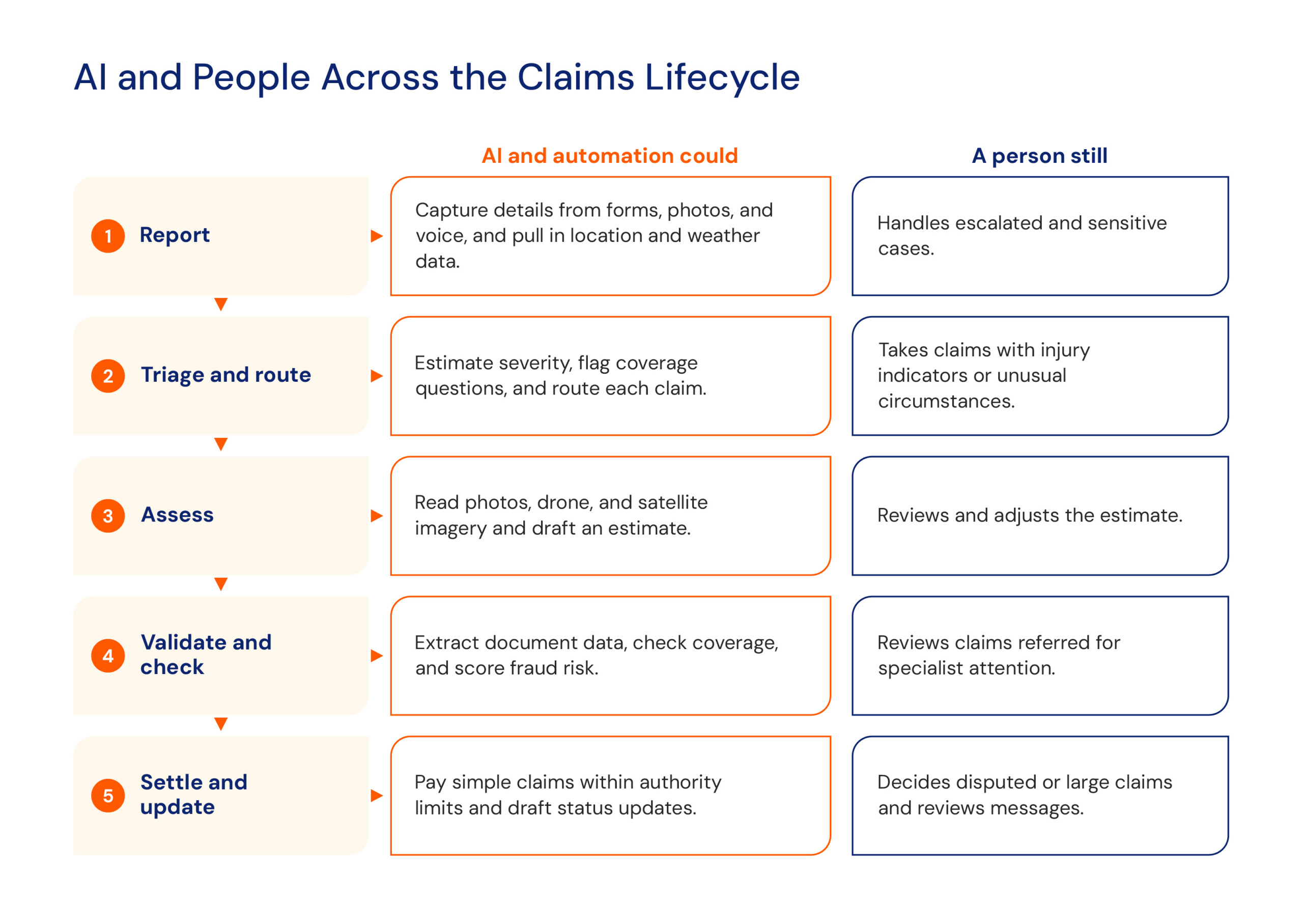
Document processing is a natural starting point. AI can extract and classify data from police reports, invoices, medical records, and correspondence, reducing re-keying and the errors that come with it. Claims validation can then check coverage, policy status, and the consistency of claim details against policy terms before a payment is considered.
Claims fraud detection may benefit from analysing patterns across claims, images, documents, and linked parties, which could flag suspicious activity earlier. A fraud score is best used to refer a claim for specialist review.
Predictive models could update reserve recommendations as new information arrives, giving finance and claims leaders a more current view of exposure. For settlement, simple claims that meet defined criteria could be paid within set authority limits, shortening the wait for the policyholder. Customer communication may also change: automated status updates keep policyholders informed, and AI could draft messages for adjusters to review before they are sent.
How far automated claims processing goes will depend on data quality, governance, and each insurer’s appetite for risk.
The Role of Human Expertise in AI-Enabled Claims
People are likely to remain central to the claims that matter most. Complex claims, such as large losses, multi-party liability, or unusual coverage questions, call for judgement that models do not reliably supply. Disputes need negotiation and explanation. Investigation often depends on interviews, site visits, and an adjuster’s sense of whether a story holds together.
Sensitive customer situations deserve particular care. A policyholder dealing with a serious injury, a bereavement, or the loss of their home is looking for empathy and clarity, and an adjuster is better placed to provide both than an automated message.
Human oversight also provides accountability. Someone needs to own decisions that affect policyholders, understand why a model recommended an outcome, and be able to challenge it. Clear rules for the escalation of exceptions, covering what the system should do when confidence is low, data is missing, or a claim does not fit the pattern, help keep that oversight practical.
Research points to where people step in. As a part of Sapiens Insurance AI Maturity Index, it was observed that among respondents whose AI-supported decisions are sometimes overridden by a person, 46% cited compliance or policy requirements and 43% cited customer vulnerability or exceptional handling as common reasons. Oversight is therefore likely to be a design requirement for AI-enabled claims.
What Could the Future Claims Organisation Look Like?
No single model will suit every insurer, but several features are likely to appear in many claims organisations as AI matures:
- Straight-through processing for simpler claims: Low-value claims with clear coverage and consistent data could be validated, approved, and paid with little or no manual touch
- AI-assisted adjusters: Adjusters may work alongside tools that summarise files, draft estimates, and suggest next steps, leaving them to decide and to speak to the policyholder
- Predictive claims management: Claims analytics could flag claims likely to escalate, leak, or settle slowly, so managers can intervene earlier
- Greater automation: Document handling, status updates, payment calculation, and routine checks may move further into automated workflows
- Human oversight for complex cases: Specialist adjusters and investigators could focus on severe, disputed, or sensitive claims, supported by clear escalation rules
The path is unlikely to be even. The Capgemini Research Institute’s World Property & Casualty Insurance Report 2026 found that only 10% of P&C insurers are successfully scaling AI, and that 42% track no AI metrics. That suggests measurement and operating-model change may matter as much as the technology itself.
Key Takeaways: Building the Future of P&C Claims
AI insurance claims programmes are more likely to succeed when you start with clear priorities:
- Start where the volume is: FNOL, triage, and document handling are practical places to begin, because they touch every claim
- Match automation to complexity: Straight-through processing may suit simple claims, while complex, disputed, and sensitive claims are likely to need an adjuster
- Treat data as the foundation: Computer vision, fraud models, and predictive analytics all depend on accurate, connected data
- Build oversight in early: Define who owns decisions, when the system escalates, and how outcomes are audited
- Measure results: Track cycle time, accuracy, leakage, and customer satisfaction so that improvements can be shown and repeated
Where Sapiens Fits
Digital loss reporting, better damage assessment, and wider automation all depend on connected data and clear rules for when people step in. Sapiens P&C brings policy, billing, and claims together on one platform, so claims sit alongside the rest of your insurance operations.
Sapiens Autonomous Insurance Platform – SapiensAIP, adds agentic AI tools to that core across underwriting, policy, billing, claims, and customer engagement. It rests on a semantic model of insurance drawn from the systems you already run, which gives AI the context to work with your own products and rules. Governance and compliance controls, including audit trails, explainability, guardrails, and human-in-the-loop review, support the oversight described above.
Frequently Asked Questions
How is AI being used in insurance claims?
Insurers use AI across the claims process: digital FNOL and automated data capture, triage and routing, computer vision for photo-based damage assessment, document processing, fraud detection, and settlement support. In most cases the technology assists adjusters by preparing information and recommending actions, while people keep responsibility for complex, disputed, or sensitive claims.
Can AI automate insurance claims?
AI can automate parts of claims handling, and straight-through processing may be realistic for simple, low-value claims with clear coverage and consistent data. Fully automating every claim is unlikely, because complex losses, disputes, suspected fraud, and vulnerable customers typically need human judgement. Most insurers are likely to automate by claim type and risk.
How does AI assess property damage?
AI assesses property damage mainly through computer vision, which analyses photos, video and aerial or satellite imagery to detect visible damage, classify its type and estimate its extent. The output can be combined with pre-loss property data, weather records, and repair-cost information to draft an estimate. An adjuster typically reviews it, particularly where image quality is poor.
Will AI replace insurance claims adjusters?
AI is likely to change the adjuster’s role, and wholesale replacement looks unlikely for now. Routine tasks such as data entry, document checks, and simple estimates may be automated, freeing adjusters for complex claims, negotiation, investigation, and sensitive conversations. Roles may shift towards judgement.
What is automated claims processing?
Automated claims processing uses software, rules, and AI to handle claims steps with little or no manual input, such as capturing FNOL details, validating coverage, extracting data from documents, scoring fraud risk, calculating payments, and updating policyholders. It aims to cut cycle times and errors on routine claims, with complex cases routed to an adjuster.
How does computer vision work in insurance?
Computer vision trains models on large sets of labelled images so they learn to recognise objects and damage patterns. In claims, a model analyses photos, drone footage, or satellite images, detects and classifies damage, and may estimate repair scope. An adjuster usually reviews the result, as lighting, angles, and pre-existing wear can affect accuracy.
How can AI improve claims management?
AI could improve claims management by speeding up triage and routing, giving adjusters a fuller view of each claim, spotting possible fraud earlier, and keeping policyholders informed. Predictive models may also help with reserving and with identifying claims likely to escalate. Gains depend on data quality, clear governance, and human oversight of automated decisions.