
You don’t own your business logic. You configured a copy of it.
Every regulated business runs on decisions. Who qualifies for the loan. How the claim is adjudicated. What the policy costs. These decisions are the business: its strategy, its risk appetite, and its regulatory posture, expressed as logic that runs thousands of times a day.
That logic is one of the most valuable assets a company has. And most companies don’t own it.
If you run a regulated business, you might reasonably disagree. You already handle this, you’d say. It’s configured in your loan origination system, your policy administration platform, the business applications that run your operation. The rules are in there. The decisions get made.
They do. But configuration is not the same as owning your logic, and the difference is where the value leaks away.
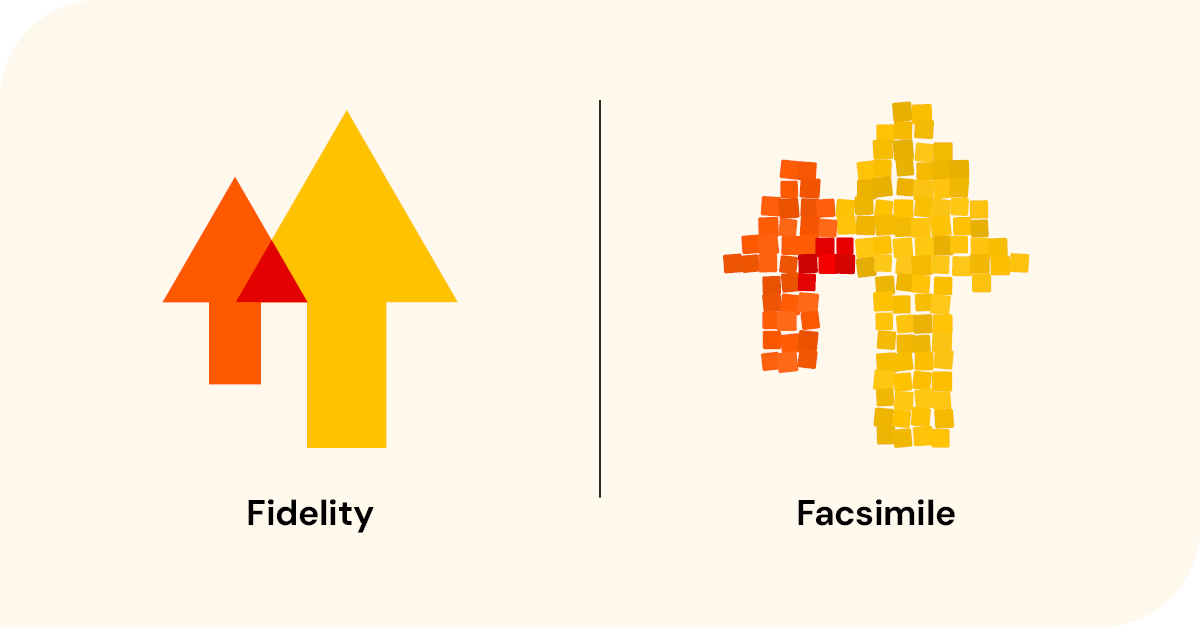
Those systems weren’t built to specialize in decisioning. They offer configurability, enough flexibility to get close to what you intend. And “close” is the problem. Your business writes a policy. Someone translates that policy into whatever the system can express. What runs in production is not your intent; it is the nearest approximation the tool allowed. Between what you meant and what actually happens, there is a gap. Most organizations have simply learned to live in that gap.
A platform built for decisioning closes it. Because it specializes in decisioning and carries a real modeling methodology, business intent can be captured with full fidelity: what you decide is what runs. And something more happens along the way. The rigor the methodology demands forces the policy to be explicit. It surfaces the ambiguities and edge cases the original policy quietly left unresolved, so you end up with a sharper, more considered policy than you started with.
The tool doesn’t just record your thinking faithfully. It improves it.
That fidelity compounds. When what runs is genuinely what you intended, you have real control. Real control is what makes you agile. You can change what you mean and see it in production quickly, rather than re-approximating it through configuration every time the market moves.
So why do so many settle for the facsimile? After many years in the field, I keep arriving at the same answer: the barrier was never really the technology, it was the specialization. Closing the gap between intent and production takes a rigorous, disciplined way of modeling decisions, and that expertise has always been scarce. Scarce expertise is a risk, so most organizations make do with what their core systems can configure.
The barrier was never really the technology, it was the specialization.
That is what is now changing. AI, and agentic AI in particular, is remarkably good at exactly this work: reading policy and regulation, translating it into structured decision models, and pushing the business to sharpen its thinking as it goes. The methodology that used to live with a handful of experts is moving into the tools. Full-fidelity modeling, the thing that was out of reach for all but the best-resourced teams, is becoming accessible to far more of them.
And that is only the input side.
The same intelligence that captures your intent on the way in can analyze your outcomes on the way out. Every decision produces a result. AI is just as good at studying those results, spotting where outcomes drift from what you wanted, and feeding that insight back to improve the policy and the models, so the next decisions are better. Intent flows in, outcomes flow out, and the outcomes teach the intent. A closed loop. We call it The Decision Loop.
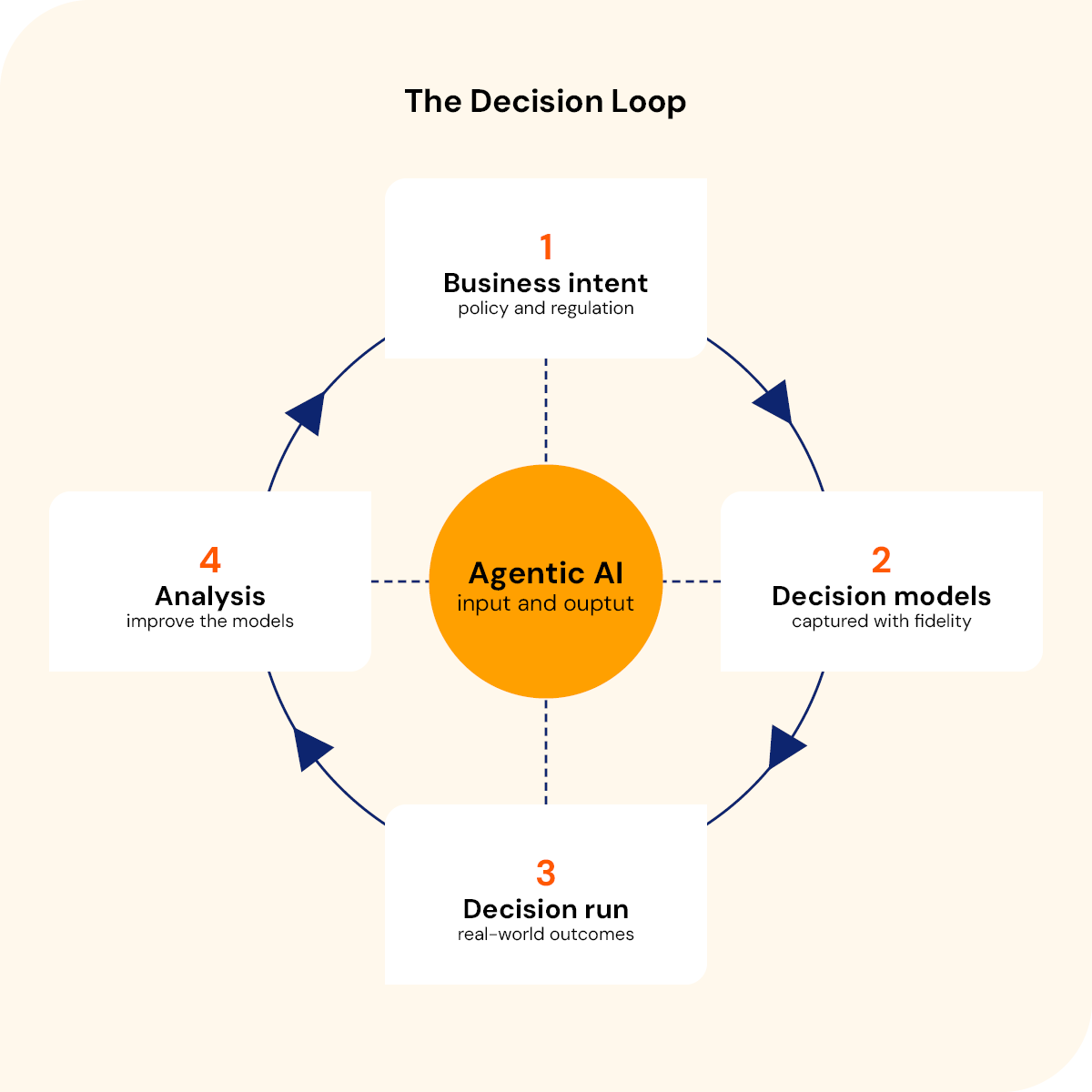
This isn’t purely aspirational. The observability exists today: we use analytics to watch outcomes, set alerts against thresholds, and test model versions against each other to see which performs. What comes next is the intelligent automation of the feedback itself, where the analysis and the improvement close into a continuous cycle with greater insight and less manual effort.
That is the real destination, and it reframes what “owning your business logic” even means. Ownership was never about capturing your decisions once and considering the job done. It means turning your logic into a living asset: one that runs with fidelity, improves with every outcome, and adapts as fast as your business does. In time, it becomes something more — a partner that thinks alongside you, surfacing insights and testing scenarios so you make sharper decisions about where to go next.
Better decisions, compounding into advantage. That’s the opportunity in front of you.