
The UK Autumn Budget: No Pensions Raid, but a Growth Ask
Yesterday, John Healey, UK Chancellor of the Exchequer, delivered a budget billed as “breathing space for today, fresh hope for the future”. The feared raid on pension tax incentives did not come to pass. In its place, the Chancellor said the government will work with pension providers, asset managers, and the wider industry to channel more private investment into British growth firms. One is a relief while the other is a request. Both affect life and pensions insurers’ operations.
Pension Capital: From Ambition to Partnership
Healey backed the request with public money: a further £20.4bn for the National Wealth Fund and the British Business Bank. The Budget report says the Mansion House Accord, where 17 of the country’s biggest providers, including Aviva, Legal and General, M&G, Phoenix, and Royal London, committed to the ambition of putting 10% of their defined contribution default funds into private markets by 2030, should unlock around £25bn for UK private markets. The government will work with providers to build on those commitments. It sits alongside the UK Scale-up Fund, where Nest, Railpen, and three Local Government Pension Scheme pools are exploring a fund for British technology firms.
The signal is partnership, not pressure. But the ambition is political, and the execution is operational. Private-market assets are harder to value, slower to settle, and awkward to run on platforms built for listed funds and annuity books. Members did not sign up to fund start-ups; they signed up for a secure retirement. Insurers will need to explain how private investment serves the saver as well as the Treasury. Trust, not capital, is the scarce resource.
The Tax-Free Lump Sum: A Rumour That Went Quiet
The second test was the tax-free lump sum. FCA data analysed by AJ Bell shows withdrawals averaging £7.9bn a year from 2018/19 to 2022/23, then reaching £18.3bn in 2024/25 and £22bn in 2025/26. AJ Bell attributes the surge to Budget uncertainty.
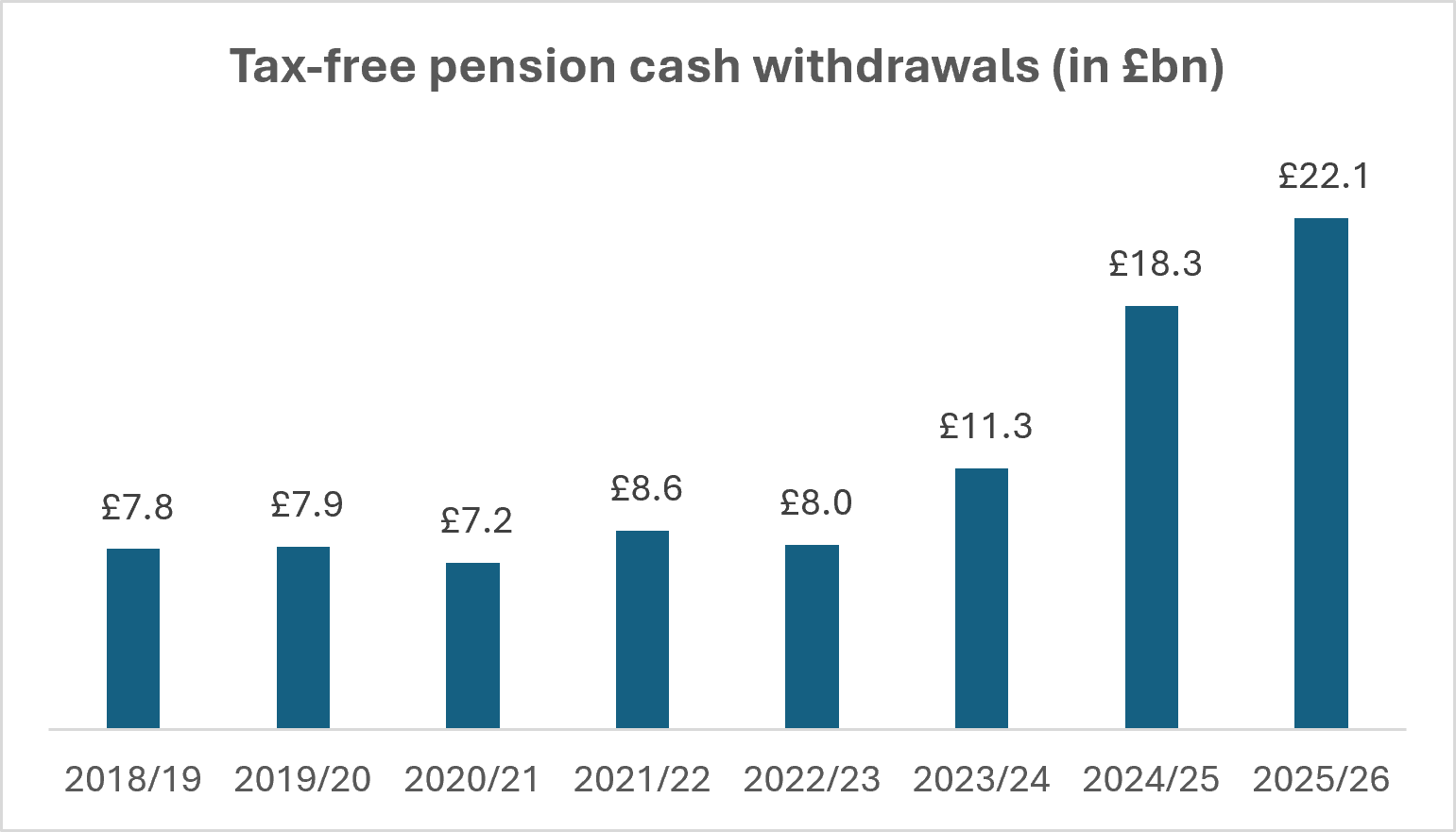
Source: FCA Retirement Income Market Data, underlying data tables 2018/19 to 2025/26 (Table 18, value withdrawn via pension commencement lump sum, all plans). Each bar adds the two half-years of a tax year (April to March).
This year was different. AJ Bell noted “mercifully little speculation” beforehand, and the Budget leaves the 25% lump sum untouched. Our own analysis of the FCA data shows that before 2024, the six months from October to March, which include the Autumn Budget, accounted for about half of each year’s withdrawals (51% on average). In 2024/25 that share reached 59%, and in 2025/26 it hit 60%.
A quiet autumn is not the same as a stable one: part of the rise may also reflect the plan to bring unused pensions into inheritance tax from April 2027, which the Budget does not change. FCA data for 2026/27 will show whether calm cut the surge. Until then, insurers need real-time visibility of customer behaviour, digital journeys that absorb surges, and proactive communication that reaches members first.
Two Themes, One Test
Neither theme is a regulatory story. One asks insurers to put capital to work in assets customers cannot see. The other rewards insurers that can tell customers, quickly and clearly, what has and has not changed. Both reward the same capability: knowing the customer, the asset, and the risk. The next checkpoint is the Pensions Commission’s final report, due in February.
With more than 40 years of experience, Sapiens helps UK life insurers and pension providers use modern technology and turn policy change into customer clarity. Contact us to find out how.