
The P&C Insurance Market Cycle: Hard vs Soft Markets Explained
Anyone who has renewed a P&C insurance programme several times has seen prices climb sharply, then drift back down. The P&C insurance market cycle describes that swing between hard and soft conditions, driven by the interplay of pricing, capacity, claims, capital, and underwriting profitability. AM Best’s preliminary 2025 results show how far it can move: the US P&C industry’s net underwriting gain nearly tripled in a year, from $22.1 billion in 2024 to $60.9 billion in 2025. This guide explains what drives each phase and what could shape the next turn.
What Is the P&C Insurance Market Cycle?
The insurance market cycle, also called the underwriting cycle or insurance pricing cycle, is the recurring pattern in which P&C insurance pricing, capacity, and terms alternate between tightening and loosening. A hard market brings higher prices and stricter terms. A soft market brings lower prices and broader cover.
Market conditions change because insurers set prices before they know their true costs. Premiums rest on estimates of future claims, and when actual losses, investment returns, or the cost of capital differ from those estimates, insurers adjust.
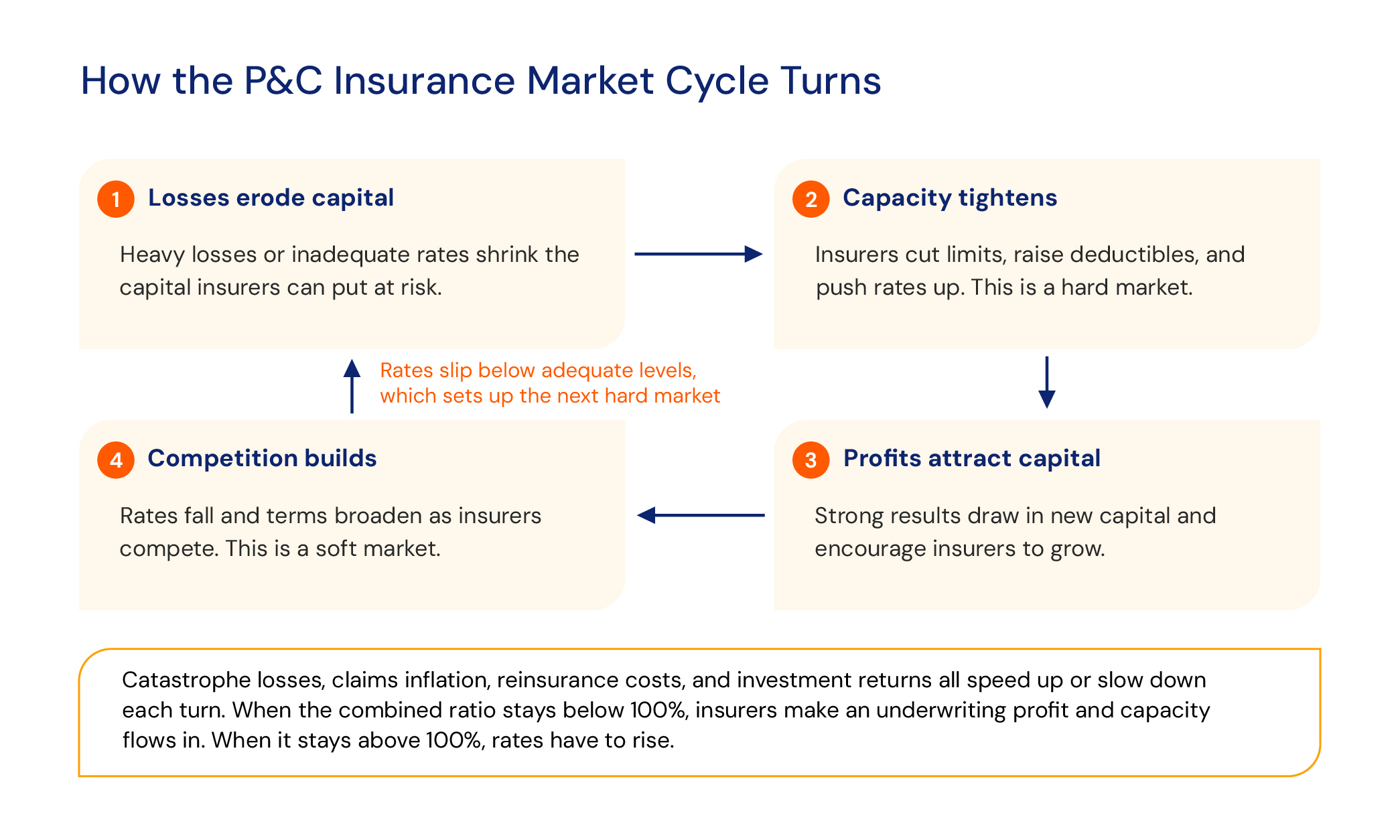
Underneath, the cycle is supply and demand. Supply is insurance capacity: the capital insurers and reinsurers are willing to put at risk. Demand from businesses and households is relatively steady. When capital is plentiful, insurers compete for that demand and prices fall. When losses erode capital, supply contracts and prices rise until returns attract fresh capital back.
What Is a Hard Insurance Market?
A hard insurance market is a seller’s market. It usually follows heavy losses, inadequate rates, or shrinking capital, and its defining characteristic is rising premiums as insurers push for rate adequacy: prices that cover expected losses, expenses, and a return on capital. Hard markets can last for years. Marsh’s Global Insurance Market Index recorded no quarterly decline in global commercial rates from late 2017 until the third quarter of 2024.
Capacity tightens at the same time, as insurers cut limits, raise deductibles, and withdraw from lines or regions with poor results. Underwriting discipline becomes the priority, with tighter guidelines, more referrals, and closer scrutiny of terms. Risk selection sharpens too. Well-managed risks with good loss records still find cover, while risks with thin data, poor claims history, or heavy catastrophe exposure may face steep increases or no capacity at all.
What Is a Soft Insurance Market?
A soft insurance market is the reverse: a buyer’s market in which capacity is abundant and insurers compete for business. It tends to follow strong profitability, which attracts new capital and encourages existing insurers to grow.
Competition drives the pricing pressure. To win or keep accounts, insurers cut rates, offer higher limits and lower deductibles, and broaden terms. Global commercial insurance rates fell 6% in the second quarter of 2026, according to Marsh, the eighth consecutive quarterly decline, with property rates down 12%.
Underwriting appetite changes as well. Insurers that withdrew from certain classes return, and some write risks they would previously have declined. The danger is that rates slip below adequate levels, setting up the losses that start the next hard market.
Hard vs Soft Insurance Markets
| Hard market | Soft market | |
|---|---|---|
| Pricing | Rising, as insurers push for rate adequacy | Falling, or rising only slowly |
| Capacity | Tightening: limits cut, some lines and regions exited | Abundant: insurers return to classes they left |
| Terms | Higher deductibles and tighter wording | Higher limits, lower deductibles, broader cover |
| Underwriting | Discipline, referrals, and closer scrutiny | Wider appetite, with growth targets pressing harder |
| Negotiating power | With the insurer | With the buyer |
| Usually follows | Heavy losses, inadequate rates, or shrinking capital | Strong profitability and new capital |
What Causes the P&C Market to Harden or Soften?
Catastrophe losses are the most visible trigger. Swiss Re Institute puts global insured natural catastrophe losses at $107 billion in 2025, even without a major US hurricane landfall. A severe year can drain capital quickly; a quiet one releases it.
Claims inflation works more slowly. Higher repair, rebuilding, and labour costs push up property claims, while litigation raises liability claim severity. In the UK, the ABI reports that motor insurers paid out £11.9 billion in claims in 2025, driven largely by the high cost of repairing today’s complex vehicles. When claims rise faster than premiums, loss ratios deteriorate and insurers seek rate increases.
Capital availability and reinsurance pricing set how much risk the market can absorb, and at what cost. Investment conditions matter because insurers earn returns on premiums held before claims are paid, so higher yields can make thinner underwriting margins acceptable. Marsh links today’s falling rates to strong insurer profitability, surplus capital, lower reinsurance costs, and higher investment returns, which together intensify competition. Insurance profitability closes the loop. A combined ratio below 100% signals an underwriting profit and attracts capacity, while sustained results above 100% force a correction.
How Do Market Cycles Affect P&C Underwriting?
In a hard market, your risk appetite narrows and your underwriters can hold out for adequate rates, tighter wording, and lower limits. In a soft market, appetite widens and growth targets press harder. Pricing discipline becomes the real test, because matching every competitor’s cut may win volume while eroding margin.
Coverage terms move with the cycle. When capacity returns, buyers tend to negotiate away the exclusions, sublimits, and higher deductibles added in hard conditions. Capacity decisions follow suit, with line sizes cut after losses and expanded when capital is plentiful.
Submission volumes often signal a turn early. When some insurers pull back, brokers market each risk more widely, and those still writing see a surge of submissions to triage. When conditions soften, submissions spread across more competitors, and winning business can depend on speed of response as much as price.
How Do Market Cycles Affect Policyholders and Brokers?
Policyholders feel the cycle most directly through premium changes at renewal. In a hard market, even accounts with clean loss records can face substantial increases, and some coverage may be unavailable or offered only with lower limits. In a soft market, premiums fall and buyers can often secure broader terms.
Negotiating dynamics shift accordingly. AM Best reports that abundant capital and heightened competition have moved more negotiating power to the buyer in the U.S surplus lines and specialty commercial market. Brokers shift from finding capacity in hard markets to improving terms and programme structure in soft ones. The same shift is visible outside North America. Lloyd’s 2025 results show a 3.7% fall in price across its market, consistent with a more competitive pricing environment, and Marsh’s Q2 2026 index recorded commercial rates down 8% in the UK and 6% in Europe.
Hard markets also push buyers towards alternative insurers and structures, including excess and surplus lines, captives, and parametric cover. The same AM Best report shows the US surplus lines market reaching $143.2 billion of direct premium written in 2025, its eighth consecutive year of double-digit growth. Policy terms change with each phase, so last year’s standard wording may not be offered at renewal.
What Role Does Reinsurance Play in the P&C Cycle?
Reinsurance is insurance for insurers, and its price and availability flow directly into primary markets. When reinsurance capacity is plentiful, primary insurers can write more business and pass lower costs on. When it tightens, they must retain more risk, buy less protection, or raise prices.
Reinsurers absorb the largest catastrophe losses, so a costly year often triggers reinsurance price rises that cascade into property pricing. Benign years work the other way: that property catastrophe reinsurance rates on line remained down around 16% globally after the 1 July 2026 renewals.
Capital is the underlying driver. Aon estimates global reinsurance capital reached a record $790 billion at 31 March 2026, largely driven by growth in alternative capital. That much capacity tends to keep reinsurance pricing competitive until losses or capital outflows change the balance.
What Could Shape the Next P&C Insurance Cycle?
Several P&C market trends are likely to influence when, and how sharply, the market next turns.
Climate-related losses could matter most. Swiss Re Institute describes the upward trend in insured losses as structural, driven by exposure growth and, in some regions, changing hazards. A severe catastrophe season could quickly test current property pricing. Claims inflation may keep casualty firmer than property, as rising US casualty rates in Marsh’s latest index already suggest.
Emerging risks may add both demand and uncertainty. AM Best notes that admitted insurers are tightening AI exclusions, leaving surplus lines as the main source of affirmative AI cover. Alternative capital could dampen future price spikes if it returns quickly after losses or prolong softening while investor appetite stays strong.
AI and underwriting efficiency may change how insurers respond. According to Aon, investment in data quality, analytics, and AI is helping expand capacity and strengthen reinsurer confidence. Better data could help insurers price more accurately through each phase, though it’s unlikely to remove the cycle. Changing regulatory and economic conditions, from interest rates and inflation to capital requirements and rules on AI use, could also bring the next turn forward or push it back.
Key Takeaways: Understanding P&C Market Cycles
Wherever you sit in the hard vs soft insurance market cycle, these points apply:
- Watch capital and capacity: price follows the capital insurers and reinsurers will put at risk
- Treat reinsurance renewals as an early signal: reinsurance costs flow quickly into primary property pricing
- Hold pricing discipline in a soft market: rate adequacy given away today often becomes tomorrow’s loss
- Expect lines to diverge: P&C can sit at different points in the cycle at once
- Use data to respond faster: insurers that can reprice, adjust appetite, and triage submissions quickly are better placed in either phase
Where Sapiens Fits
Responding to the cycle depends on how quickly you can change prices, products, and appetite. Sapiens Property & Casualty lets you adjust pricing and launch products quickly through flexible product configuration and low-code tools. SapiensAIP, the Sapiens Autonomous Insurance Platform, adds insurance-specific AI agents on top of Sapiens Core to automate underwriting workflows, with underwriters reviewing and approving recommendations, so your team can keep pace when submission volumes swing with the cycle. AI decisioning built into underwriting scores incoming risks in real time and flags complex submissions for human review. In our Insurance AI Maturity Index,, it was observed that 45% of the 475 senior insurance professionals surveyed reported AI live in production in underwriting at their organisation.
Discover how Sapiens P&C insurance software can support modern pricing and underwriting operations as part of a connected insurance platform.
Frequently asked questions
What is the P&C insurance market cycle?
The P&C insurance market cycle is the recurring shift between hard and soft conditions in property and casualty insurance. In hard markets, premiums rise and capacity tightens. In soft markets, capacity is plentiful and prices fall. It’s driven by losses, claims inflation, capital, reinsurance costs, investment returns, and competition.
What is a hard vs soft insurance market?
A hard insurance market typically means higher premiums, stricter underwriting and less available coverage, giving insurers greater pricing power. A soft insurance market generally means lower or more stable premiums, broader coverage and greater competition among insurers, giving policyholders more choice and negotiating power.
What causes insurance markets to harden?
Insurance markets harden when losses and costs outpace premiums and erode capital. Common triggers include major catastrophe losses, claims inflation, rising reinsurance prices, weaker investment returns, and sustained underwriting losses. As capital shrinks, insurers cut capacity and raise rates until pricing is adequate and profitability returns.
Why do P&C insurance rates increase?
P&C insurance rates increase when insurers expect claims and costs to exceed current premiums. Drivers include catastrophe losses, higher repair and rebuilding costs, rising liability claim severity, more expensive reinsurance, and lower investment income. Rates also rise in hard markets, when reduced capacity gives insurers more pricing power.
How does reinsurance affect insurance pricing?
Reinsurance affects insurance pricing because primary insurers pass on the cost of the protection they buy. When reinsurance is plentiful and cheap, insurers can write more business at lower prices. When reinsurance prices rise after major catastrophe losses, insurers retain more risk or raise premiums, especially in property lines.
What affects P&C insurance capacity?
P&C insurance capacity depends mainly on the capital insurers and reinsurers are willing to commit. It grows when profits are strong, new investors enter, and reinsurance and alternative capital are plentiful. It shrinks after large losses, adverse reserve development, or regulatory and rating pressure to hold more capital.